“Life is a Miracle: Strategic Communications in an Age of Rupture”
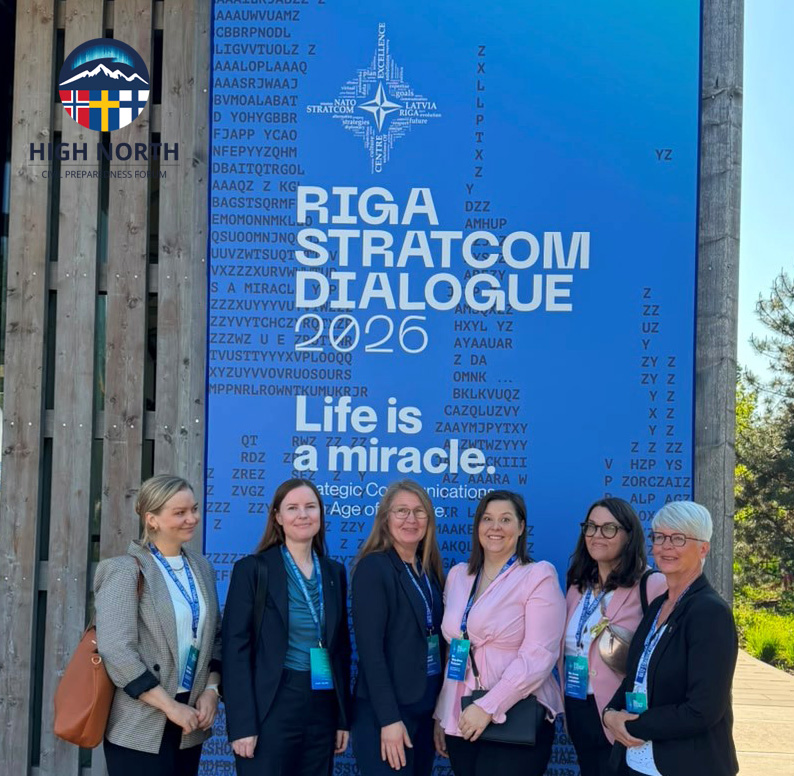
Hosted by the NATO Strategic Communications Centre of Excellence, this year’s conference was held under the theme “Life is a Miracle: Strategic Communications in an Age of Rupture.” The event focused on the challenges and opportunities emerging from rapid technological change, geopolitical competition, and the growing influence of artificial intelligence on communication and security.
Security experts, policymakers, military leaders, researchers, and technology specialists gathered in Riga to discuss the future of strategic communications in an increasingly complex global information environment.
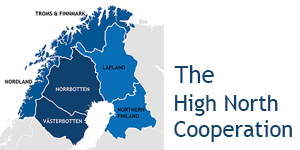
Among the participants was the Crisis Communication Network of the High North Cooperation (HNC), represented by communication professionals from the northernmost regions in Finland, Norway and Sweden. The network took part in discussions and knowledge-sharing sessions focused on resilience, crisis communication, information integrity, and cross-border cooperation in an evolving security environment. The conference provided an opportunity to exchange experiences and strengthen professional networks among experts working with strategic and crisis communications.
– The conference gave us a deeper understanding of current information influence activities, and it also strengthened our international network, said Vilde Øines Pedersen from the County Governor of Troms and Finnmark in Norway.
Speakers addressed the increasing use of foreign information manipulation and interference (FIMI) as a tool of strategic competition. Experts emphasized that hostile actors are integral increasingly sophisticated methods to influence public opinion, undermine trust in institutions, and exploit societal divisions. Building resilience against such threats was identified as a key priority for governments, organizations, and civil society.
An important theme was the role of strategic communications in national security. Participants stressed that communication is no longer merely a supporting function but has become a fundamental component of crisis management, deterrence, and resilience. Effective communication strategies were described as essential for maintaining public trust and strengthening democratic institutions during periods of uncertainty. A central topic throughout the conference was also the impact of AI on the information environment.
– The visit provided valuable insights into information influence activities and gave us a better understanding of how different organizations address these challenges, noted Jeanett Enstedt from the County Administrative Board of Norrbotten, Sweden.
Visit at NATO StratCom Centre of Excellence
Per Erik Nilsson at the Stratcom Centre of Excellence (StratCom CoE) received and welcomed the network at the centre.
The aim for the visit was to learn more about NATO StratCom CoE and discuss the process of creating a FIMI strategy in the High North.
In the project High North Civil Preparedness forum (HNCPF) an activity is to develop a joint strategy for countering information influence (FIMI) “over the borders”. The strategy will describe how the network, along with stakeholders in the region, will work together to counter information influence.
– Together with representatives from the NATO StratCom Centre of Excellence, we discussed the challenges and opportunities of developing strategies across national borders. We gained valuable insights into tools for monitoring media and social media and had interesting discussions about narratives in the Arctic, said Lilian Johansson from The Administrative Board of Västerbotten in Sweden.
Facts about NATO StratCom CoE
The NATO Strategic Communications Centre of Excellence is a NATO-accredited centre of expertise based in Riga, Latvia. Its purpose is to strengthen NATO’s and member nations’ capabilities in strategic communications. While accredited by NATO, it is not part of NATO’s formal command structure; instead, it serves as a research, analysis, training, and advisory institution (stratcom.org).
About High North Civil Preparedness Forum

The High North Civil Preparedness Forum is a three-year, EU-funded, Interreg Aurora project lead by the High North Cooperation. The project aims to strengthen interregional collaboration within civil preparedness in northern Finland, Sweden and Norway. The target groups for the project’s activities are key civil preparedness stakeholders in the in the region, such as municipalities, agencies, and volunteer organisations.